What Is Self-Publishing? A Beginner's Guide to Publishing Your Own Book


A finished manuscript that never reaches readers serves no purpose at all. You might believe a traditional publisher must say yes before your book sees store shelves.
That assumption has stopped thousands of good books from ever being read. Now, the self publishing industry has transformed the fates of authors who do not want the hassle of traditional publishing.
What is self-publishing? In this publishing type, you become the publisher yourself, not an applicant waiting for permission. Your book idea can transform into a finished product without any contract from a New York office.
Many first-time authors find this freedom surprising at first. Our guide has explained costs, timelines, and practical choices involved to get started, all of which have been simplified. You will get a clear walkthrough for someone who knows nothing about publishing yet. Your next steps start below.
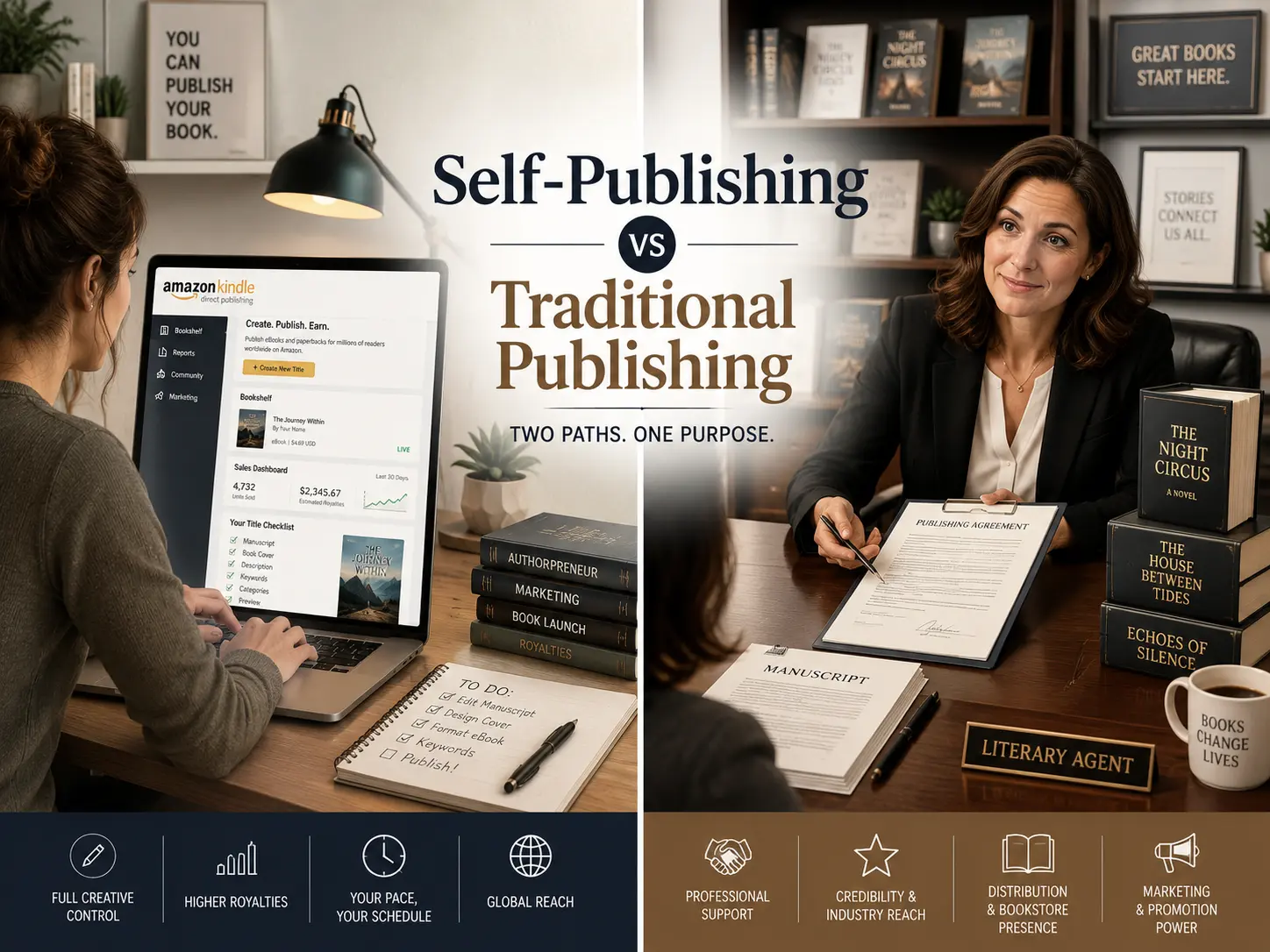
The method called traditional publishing works like a job interview where only one person gets hired. You send your book to a company, and then you wait for months hoping they call you back.
If they do say yes, they give you an advance, which acts like a loan against your future sales. You do not see another dollar until your book earns back that entire advance first. Meanwhile, the company keeps roughly 85 to 90 percent of every hardcover sale after that point.
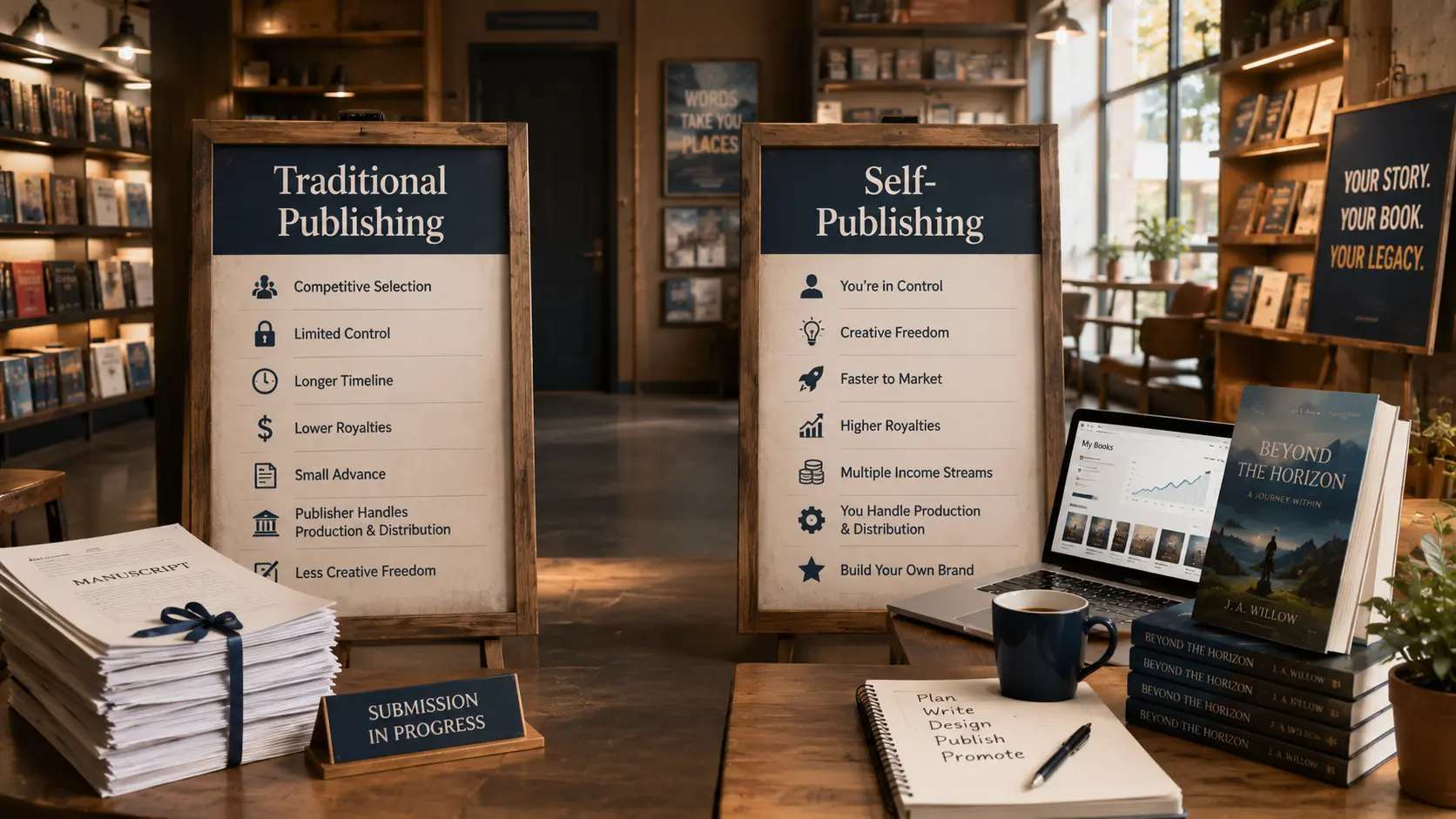
Now look at the table below to see exactly how the two types compare, using data from Publishers Weekly and market research.
| Traditional Publishing | Self Publishing |
|---|---|
| You receive an advance (a loan against future sales) then earn 10-15% of hardcover sales after paying that loan back | You keep 60% or more of profits from the very first copy sold because no advance exists to repay |
| A publisher decides if your book gets printed based on their sales predictions | You decide when your book goes live without needing anyone's approval first |
| Titles can take 12-24 months to reach stores due to printing and distribution schedules | Your book can sell online within days because digital files are printed on demand |
| Traditional output rose 6.6% in 2025 to 642,242 books | Self-published output soared 38.7% to over 3.5 million books in 2025 |
Those numbers tell a clear story about where authors are choosing to go. Think about that difference for a moment: more than five times as many people published their own books last year.
Let’s look at the case of a former Penguin Random House US CEO who started a new company in 2023. It guaranteed authors at least 60 percent of profits with nothing paid upfront.
That company sold close to one million copies of a single title across multiple formats. These differences ultimately decide one thing: whether you spend years hoping someone says yes or put the effort in getting your book ready for sale.
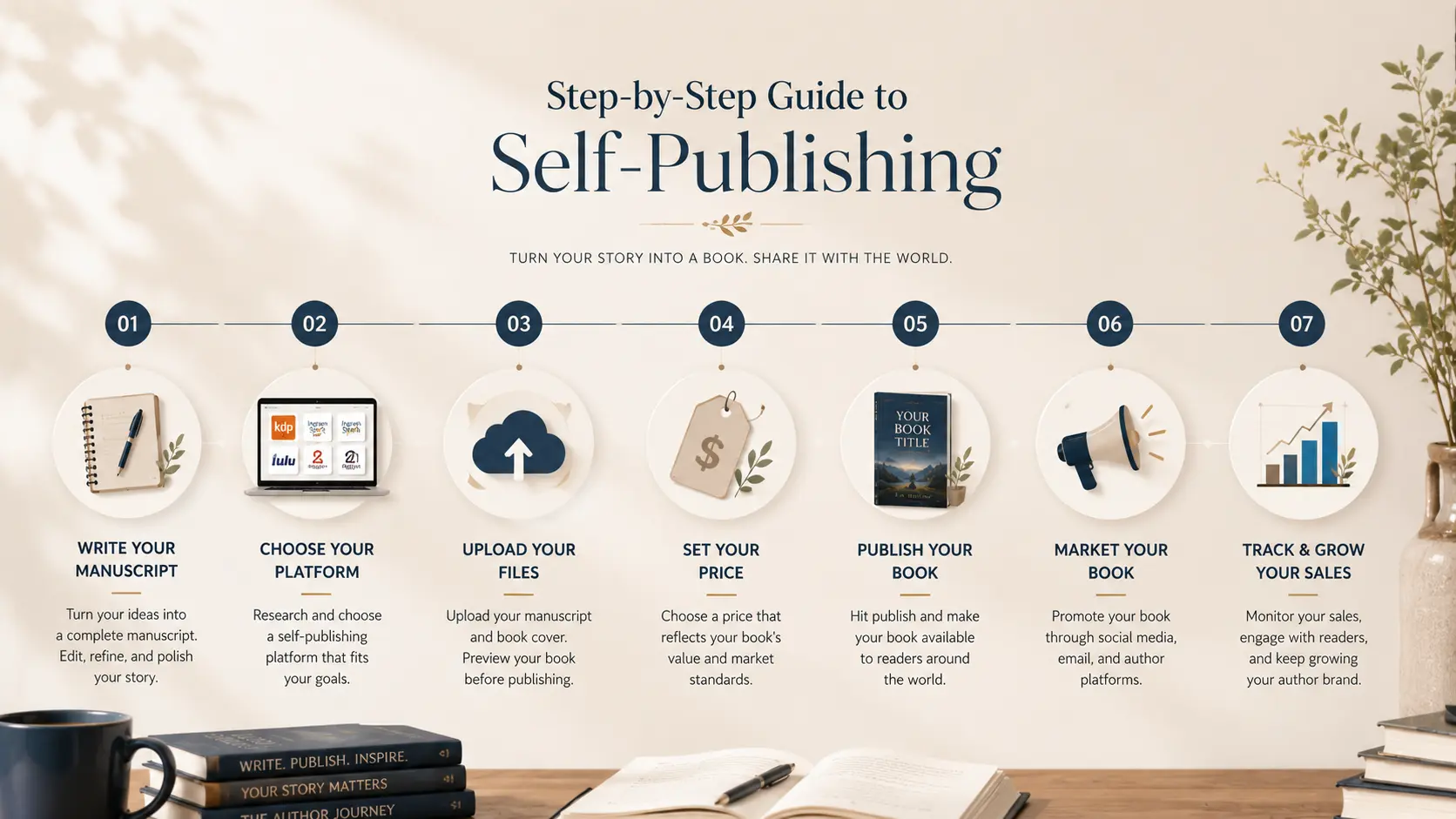
Learning how self-publishing works takes less time than brewing a pot of coffee. Around the world, readers spent nearly one billion dollars on self-published books during 2024 alone.
That impressive figure comes from market researchers who track book sales across dozens of countries. You do not need any special training or experience to follow the six steps listed below.
A platform works like an online store that prints your book but only after someone actually buys a copy. Because of this setup, you will never have to stack cardboard boxes full of unsold books in your living room.
Amazon KDP, Apple Books, Barnes & Noble Press, and Kobo are among the major options available to beginners.
Uploading means moving your document from your computer over to the platform's website.
Once that transfer happens, the platform automatically transforms your plain words into a professional-looking book layout. You do not need any designing or formatting skills to make this work properly.
Every copy that sells puts money directly into your pocket without any delays or deductions. A traditional publisher would stand in the middle and take most of your profit, but that does not happen here. Even a book that sells only a few hundred copies can still generate real income for you over time.
According to market researchers, the global self-publishing market was valued at $960 million in 2024. Those same researchers expect that number to climb to $1.36 billion by 2031.
Your book can appear on major marketplaces, digital reading apps, and national bookstore chains all at the exact same time. Just ten years ago, that kind of wide access would have been impossible for an independent author to achieve on their own.
Industry analysis now shows that self-publishing has become a completely normal and respected path for authors. It is no longer viewed as a weird side hobby or a last resort for rejected writers.
Using their own effort and a finished manuscript, authors on major platforms have sold millions of copies. Most of those sales are electronic files that get delivered instantly to a reader's phone or tablet within seconds.
Yet print-on-demand physical books continue to grow every single year, with copies being shipped directly to readers' front doors.
Rights are just a fancy word for who legally owns your words and your story from a legal standpoint. With this publishing type, no contract will ever suddenly force your book to disappear from stores without warning.
Your work remains available for as long as you want to keep selling it, which could be ten years or even decades from now.
The rise of self-publishing platforms has become a major force that is driving the entire book industry forward. Now, regular people can publish books without asking anyone for permission first.
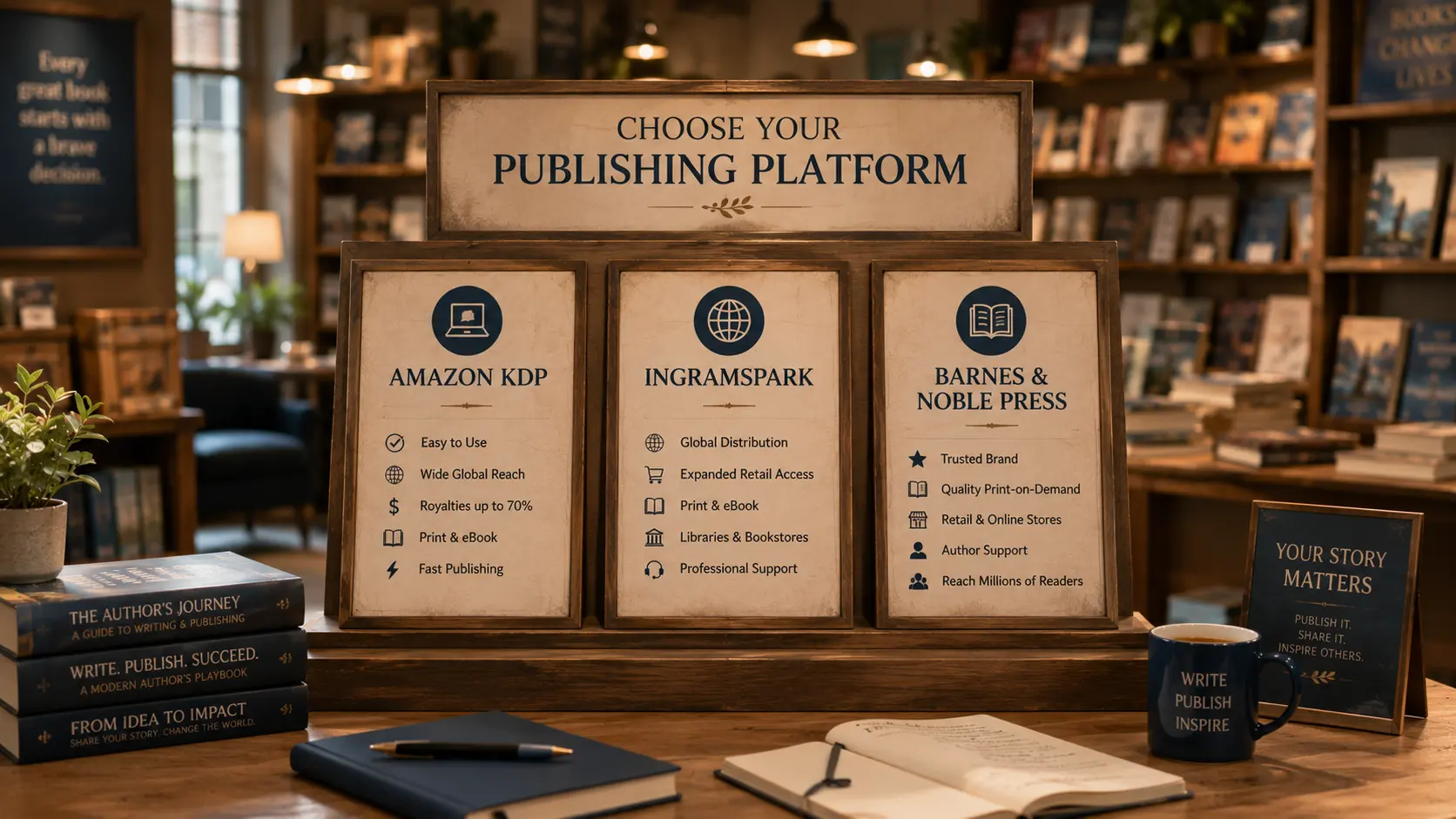
Amazon is not the only place where self-published books can be sold. This assumption falls apart once you learn how modern distribution actually works behind the scenes.
To publish a book independently is more than just uploading a file to one website. Your title can reach readers across thousands of different sales channels all at the same time. A sales channel is any store, library, or website that makes your book available for purchase.
One major distributor connects independent authors to more than 40,000 bookstores, libraries, and retailers around the entire world. This number includes small neighborhood shops, massive chains, and everything sitting between those two extremes.
Here is where your book can actually be sold:
The best part about these platforms is that you never have to pick just one option. Your title can live on Amazon while also appearing in physical bookstore catalogs and public library systems simultaneously.
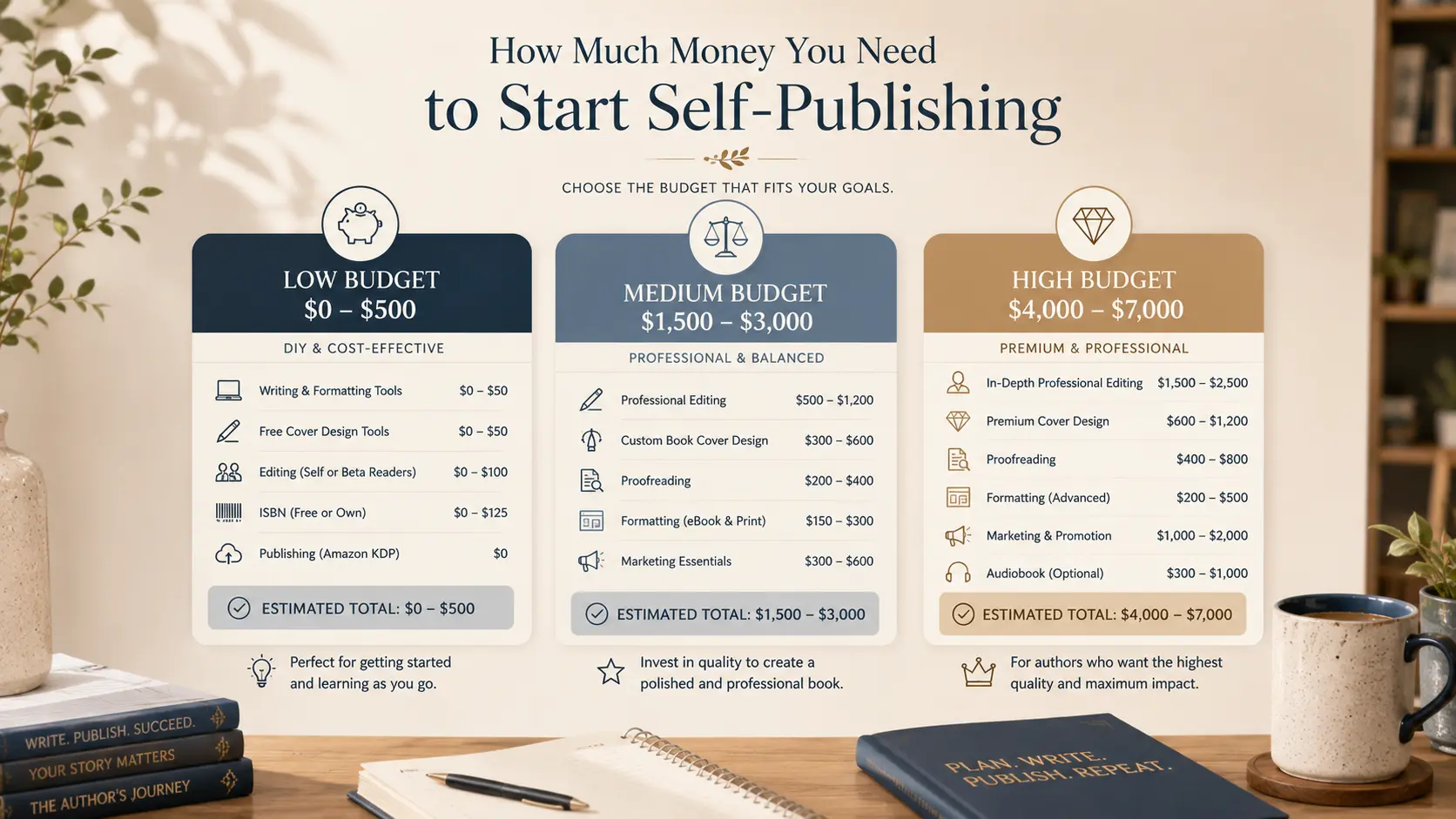
Money worries stop more first-time authors from publishing than any other obstacle they face. Here is the truthful breakdown of what self publishing a book actually costs these days. This data comes from author-reported figures gathered across thousands of solid publishing projects.
This path forces you to perform every single task by yourself without outside help. Writing, editing, book cover design, and page formatting all come from your own effort and time.
Multiple free online tools exist to help with layout, basic proofreading, and cover templates. You spend hours learning and doing each step. The final quality depends completely on how much skill you already have or are willing to learn.
At this level, you finally hire a professional editor to review your finished manuscript carefully. For a 60,000-word book, professional proofreading averages around $1,200 based on current industry rates.
Then comes the cover. A simple pre-made cover purchased from an online marketplace adds another $200 to $400. To keep your interior page layout costs at zero dollars, you can use free formatting tools. This combination catches most remaining spelling and grammar errors without breaking your budget.
This higher tier includes both professional book editing and proofreading services for your manuscript. For an 80,000-word book, copy editing averages $2,160 and proofreading averages $1,600.
In addition to this, a custom cover created by an experienced designer ranges from $500 to $2,000 depending on complexity. This entire spending level matches the quality standards found in traditionally published books from major publication houses.
Now, there are countless free tools that can help you save significant money on the lowest end of this range. The right budget for your project depends on your personal goals, your available timeline, and how much work you can successfully complete alone.
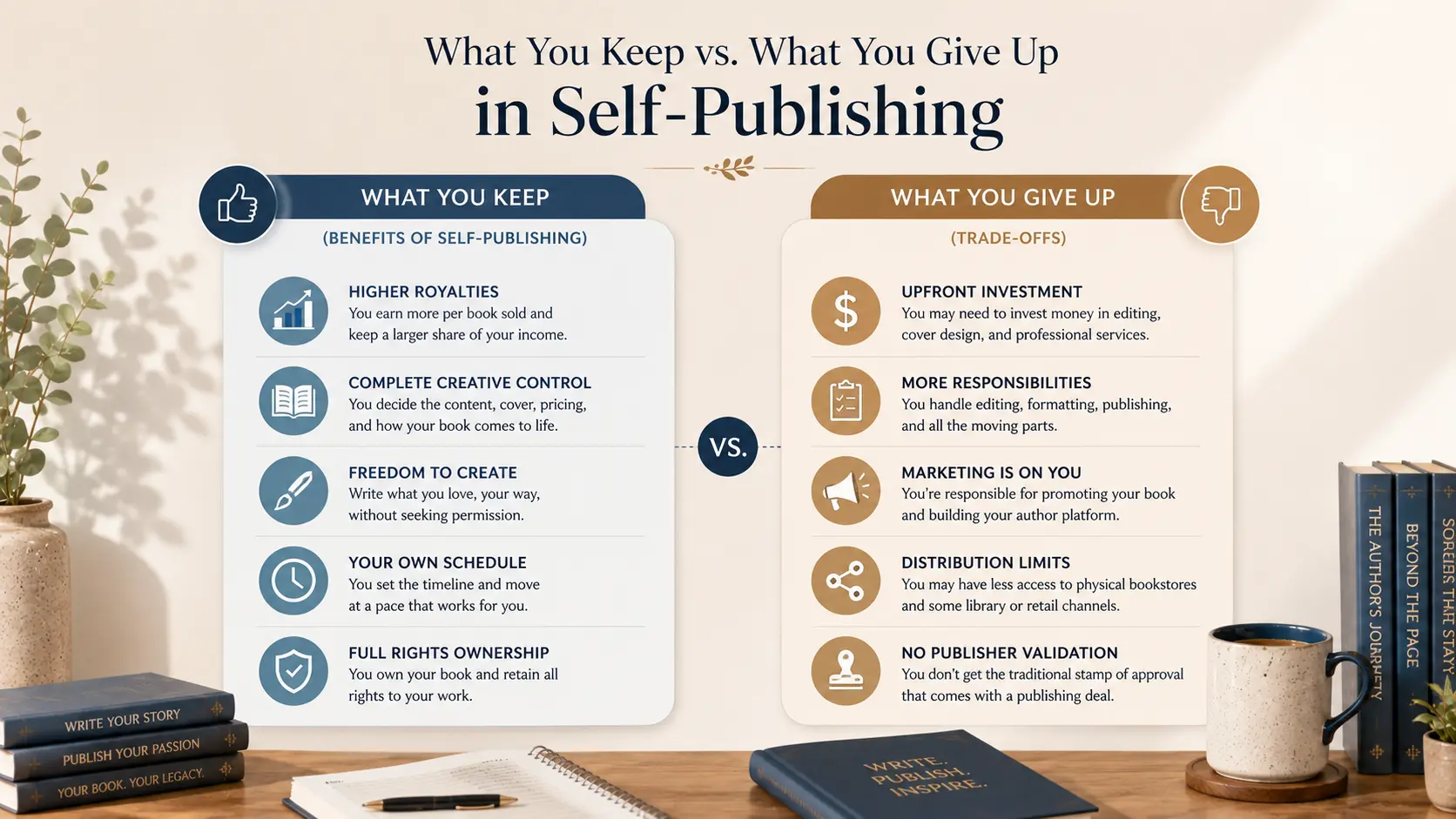
Choosing this path means trading one set of advantages for another. When you opt for this publishing type, here is what you actually keep (benefits) and what you give up (trade-offs).
What You Keep (Benefits of Self Publishing)
What You Give Up
The final question comes down to what matters most to you as an author. Do you want complete control over every decision, or would you prefer a safety net from a traditional publisher instead?
Your honest answer to that single question will determine which path makes the most sense for your book and your career.
Many first-time authors plan their schedule far too tightly and then panic at the last minute.
The fix: Plan at least four months ahead, since editors and designers often book out that far in advance.
Self-publishing demands as much attention to production as it does to creativity and storytelling.
The fix: Get at least three quotes from different printers and ask to see paper samples before paying anyone.
Poor line breaks, tiny fonts, and awkward spacing quietly tire out your readers and may reduce or stall book sales overtime.
The fix: Hire professional book editing services or use quality templates so readers glide over words without noticing the layout.
Slow down your timeline, because rushing leads to bad decisions that you cannot easily undo later.
Hire professional book publishing services where their skills matter most, such as editing and cover design.
Make every single choice intentional rather than something you just stumbled into without thinking.
The difference between an amateur project and a professional one usually comes down to avoiding just these three errors.
For that reason, take your time and do each step properly instead of racing to the finish line like so many beginners do.
You finally understand what self-publishing actually demands from authors. This path puts you in complete control while giving you much higher royalties than traditional deals. In addition, you can sell your book within days instead of waiting years for approval from some publisher.
This freedom does not come for free. You handle every bit of production work, pay every single upfront cost, and market your own book entirely alone without any help from a big company. The right time to start comes after you have mapped out a realistic timeline and saved a budget that fits your personal goals for quality.
Open a blank document first, write just one single page, and then see how the whole process feels before you spend any money on hiring professionals. Plenty of successful authors began exactly where you are sitting right now, with nothing more than a finished manuscript and the simple courage to self publish.
Before people publish their first book, most of them lie awake worrying about the same few problems. Your own self book publishing journey will likely raise these same questions, so here are straight answers that actually help.
You do not need to form an LLC at all for your debut book, because most first-time authors are simply testing the waters with their very first title.
Setting aside at least four months is a smart move for any beginner. This is because professional editors and cover designers usually book their schedules several weeks or even months ahead of time.
Yes, surely. There are plenty of free formatting tools that exist online and work well enough. But keep in mind that the final quality of your book depends entirely on how much skill you already have with design and editing.
Yes, you keep full ownership of everything you write when you publish through KDP. Your publishing contract will safeguard your book from getting pulled off the market without warning, as long as you respect the platform’s policies.
Rushing their timeline and then freaking out at the last minute. This one error destroys the sales of otherwise great books more often than anything else.
You can publish completely without an agent, since self-publishing means exactly what it sounds like. You handle everything yourself or hire freelancers directly with no middle person taking a cut of your sales.
Plan to save somewhere between $3000 and $5000 before you begin. This covers professional editing, a decent cover design, and interior formatting all bundled together.
This is no longer the case. Platforms like IngramSpark now connect writers like you to more than 40,000 bookstores and libraries all around the world.