Self-Publishing vs Traditional Publishing: Which Is Best for First-Time Authors?

You have a finished manuscript sitting on your computer, but now what? Most new authors freeze right here as information available online seems to insist their way is the only way, either traditional or self publishing.
This decision affects your wallet, your calendar, and how much you actually receive over your own book.
Let us cut through the noise. In our guide below, you will see exactly how both options work, what they really cost, and which one fits your situation. This will help direct you toward a particular decision and outcome.
So if you have been considering self publishing a book, this is your honest starting point.
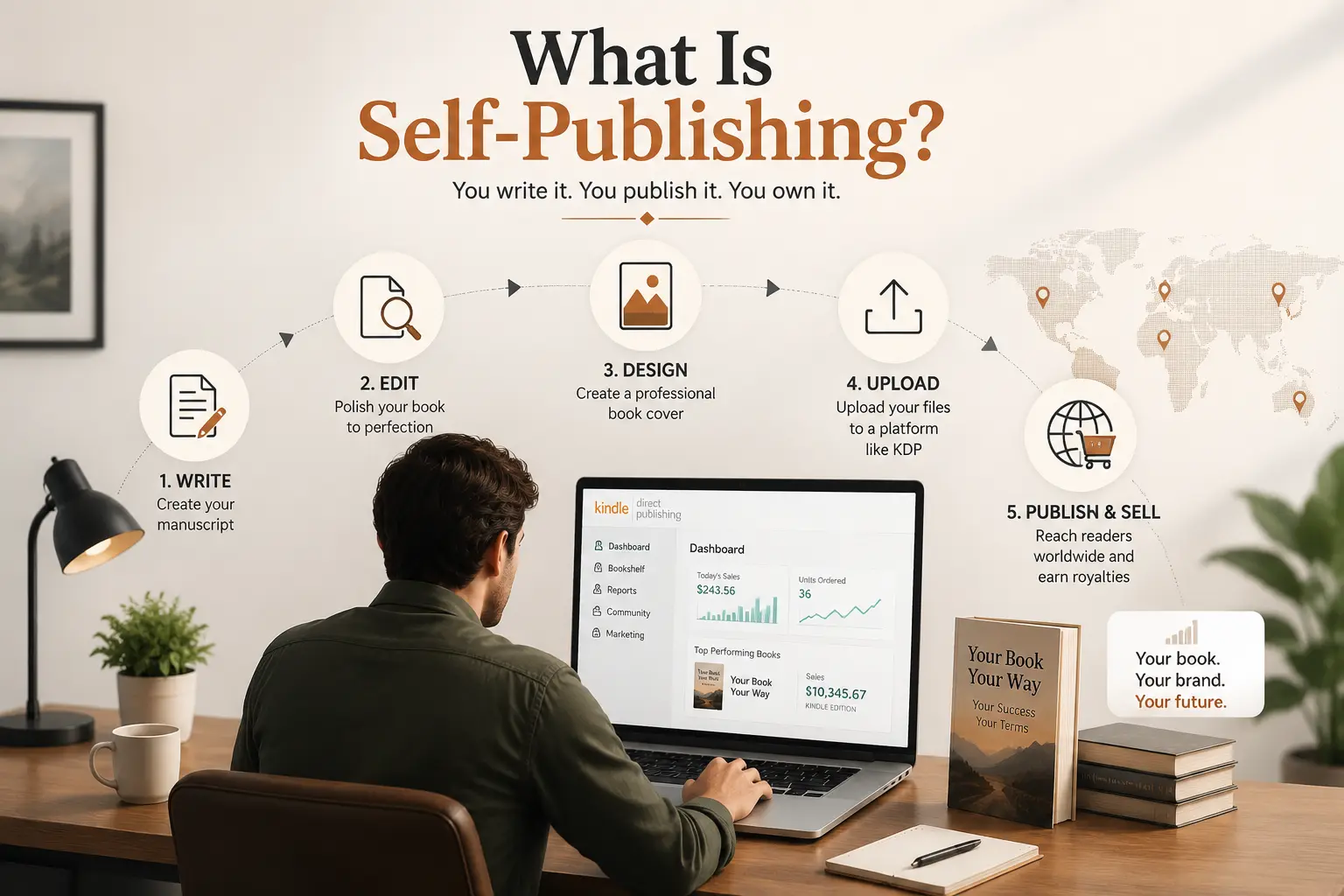
Self publishing a book is fairly simple to understand, meaning that you become the publisher. This involves you hiring an editor yourself, paying someone to design your cover, and formatting the pages.
You then upload the complete file to a site like Amazon. You can publish a book on Amazon using a completely free platform called Kindle Direct Publishing, or KDP for short.
You upload your manuscript file and your cover image, enter your price, and within one to three days, your book goes live and becomes available for purchase to readers around the world.
According to QYResearch, the global market for self-published books reached $967 million in 2025. This is nearly one billion dollars, so clearly this is not a minor side option anymore but is becoming more common with thousands of authors opting it.
If you're unfamiliar with the concept, read our detailed guide on what self-publishing is before deciding which publishing route is right for you.
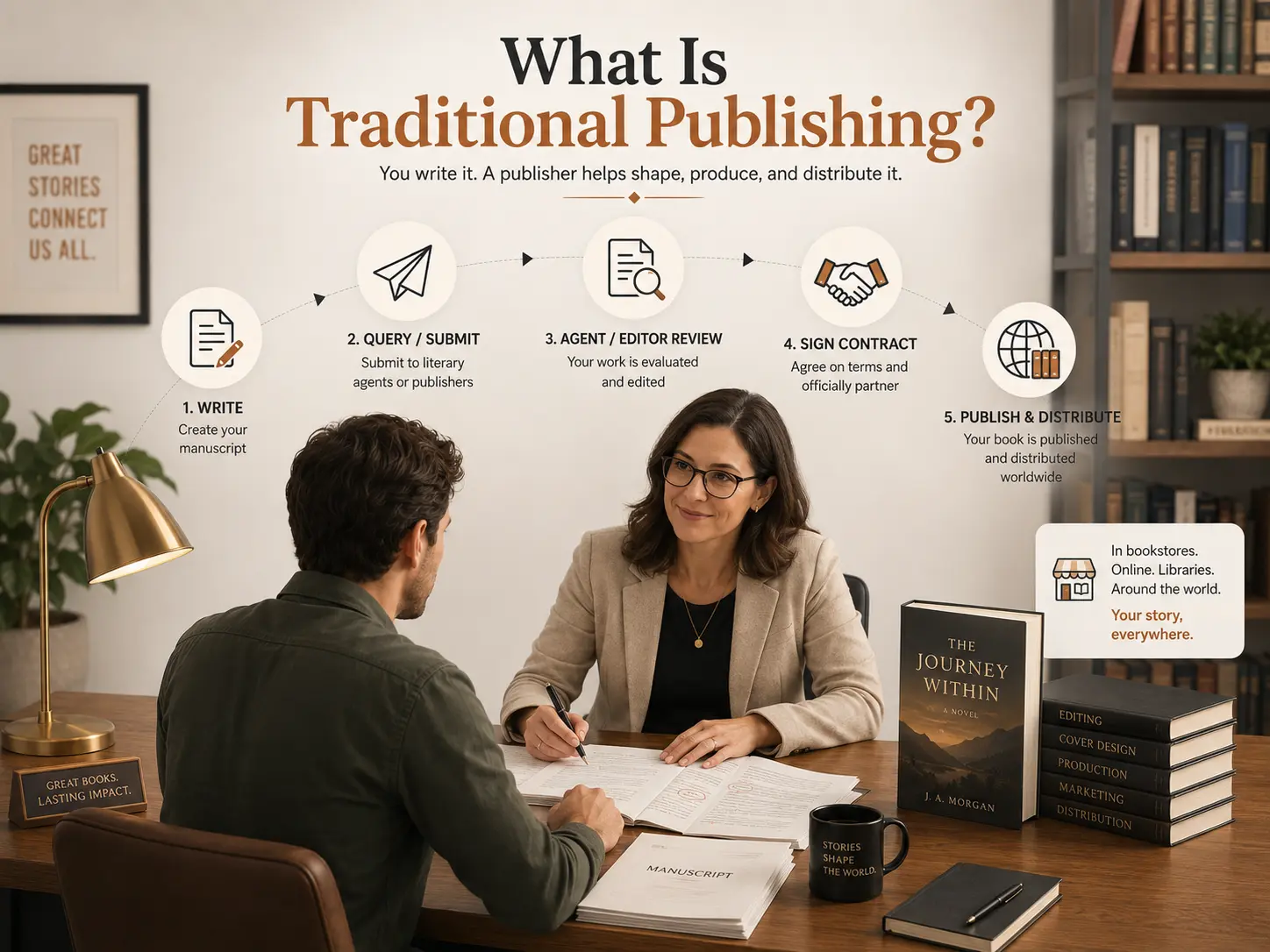
Traditional publishing is the established route. You begin by finding a literary agent, and once they connect with your book, they pitch it to book publishers.
If a publisher agrees, they handle the expensive elements like editing, cover design, printing, and getting your book into actual bookstores. In return, you receive an advance check upfront and then royalty checks later.
Getting in is difficult though, mainly because agents and editors decline submissions constantly. The timeline presents another challenge. From the day you sign that contract to the day someone picks your book off a shelf, plan on two to four years.
This is a considerable amount of time, which means your manuscript from this year might not see daylight until 2028 or even later
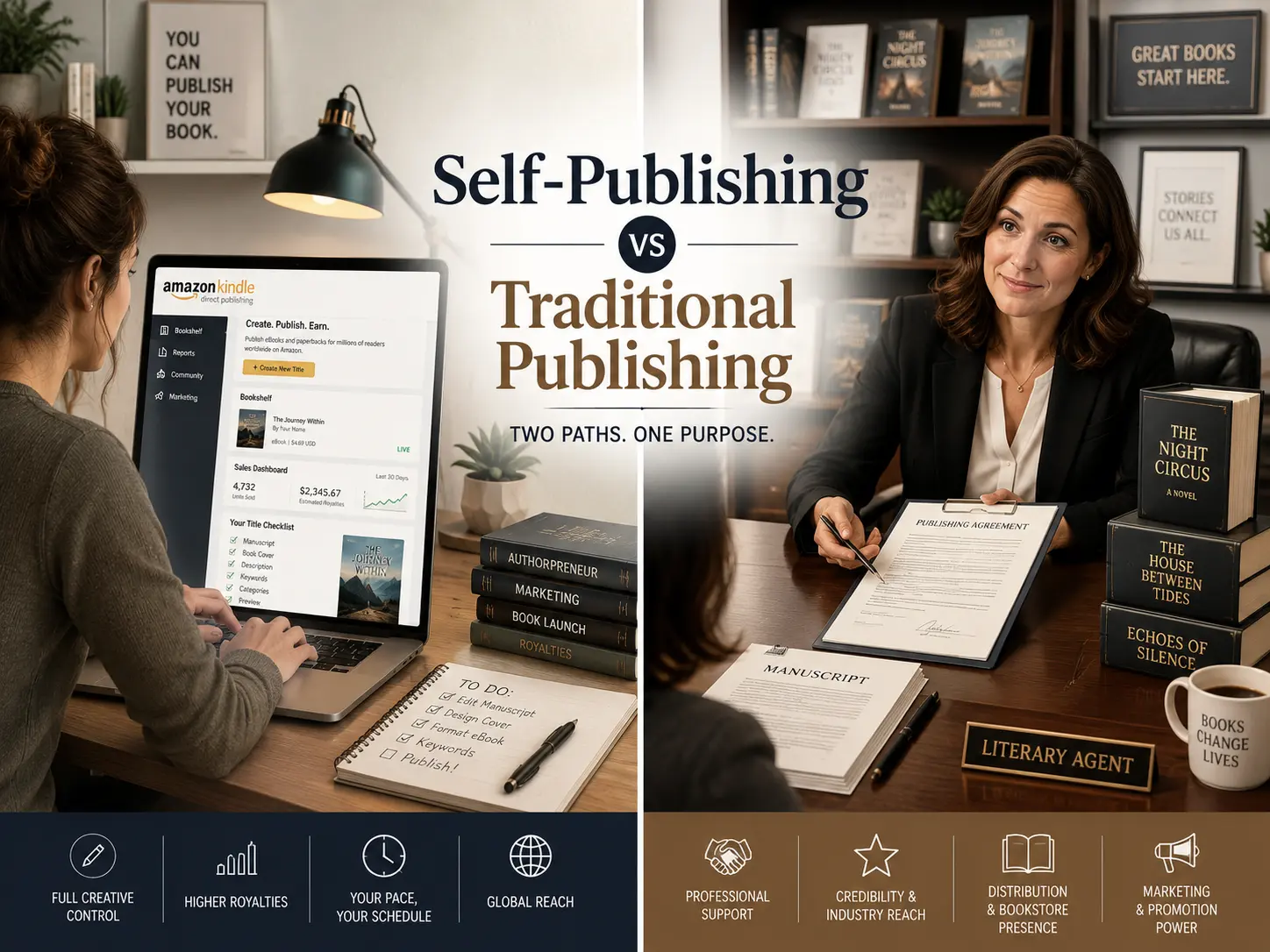
The differences between these two paths is not overly complicated. It comes down to six categories that actually keep first-time authors awake at night.
| Factor | Self-Publishing | Traditional Publishing |
|---|---|---|
| Control | You decide everything about your book, from content and cover design to pricing and release date | The publisher has final authority over key decisions including editing, design, pricing, and distribution |
| Cost | You invest upfront costs, typically ranging from $500 to $5,000 for editing, design, and marketing | The publisher covers production and distribution costs and may pay you an advance |
| Time | Your book can move from final draft to market in as little as 3–8 months | Publishing timelines typically range from 2–4 years after manuscript acceptance |
| Royalties | You earn 40%–70% of each sale from the first copy sold | You generally earn 5%–15% royalties per sale after earning back any advance paid by the publisher |
| Marketing | Marketing and promotion are entirely your responsibility | Marketing support is shared, though authors are often responsible for roughly half of promotional efforts |
| Entry Barriers | There are virtually no barriers to entry since anyone can upload and publish a book | Entry barriers are high, requiring approval from agents, editors, and publishing houses |

Full control is the most appealing benefit since you select everything yourself. This includes your cover, design, tone, basically every single change or idea that you picture. You also have the liberty to set the price as per your choice.
Faster publishing allows your book to move from a finished manuscript to available on shelves in weeks or months instead of years. This is particularly significant if you write about topics that evolve quickly, such as starting a business or raising young children.
Higher royalties are given with self publishing. You keep forty to seventy percent of every sale, while traditional publishing gives you only five to fifteen percent after deduction of your advance.
For example, on a twenty dollar book, self-publishing puts eight to fourteen dollars in your pocket, whereas traditional publishing puts just one to three dollars.
Global reach becomes possible because the publishers you partner up with operate online. Amazon KDP and similar platforms make your ebook available in dozens of countries within hours.
You handle marketing entirely alone. Every single post on social media, newsletter you send, and every small promotional effort has to be performed by you unless you hire a professional book publishing service.
Upfront costs can add up quickly because of the need for professional editing, cover design, and formatting that run between $500-$5000. You have to factor in the money before you receive any royalties.
Quality rests on your shoulders completely from hiring a qualified editor, to approving the final design of your book. This may become manageable if you work with an expert team who knows the ins and outs of the industry.
Professional support becomes available the minute a publisher accepts your book. You suddenly gain access to people who perform this work for a living, editors who understand what sells, designers who know book covers, and publicists who have contacts at magazines and podcasts.
Established distribution solves a problem that self-published authors struggle with every day. Traditional publishers have relationships with bookstores and wholesale distributors that help massively during the book distribution process.
Credibility factor becomes essential in the publishing industry especially during the audience acceptance stage. Major publishers have built their audience over years of providing quality content and access to brilliant authors. This built-in trust matters, especially for first-time authors with no reputation yet.
Hard to get accepted as literary agents and publishers only accept a small portion out of the thousands of submissions they receive. Even a well-written book may still receive a rejection if the market feels crowded or the topic does not fit what publishers want at that moment.
Slow process from signing that contract to finally seeing your book in a store, expect two to four years to pass. It may also happen that a topic sounding urgent today might lose its relevance by the time your book gets to the shelves.
Less creative control means your publisher receives the final word. They can change your title, replace your cover art, or ask you to rewrite sections. Your vision bends to fit what their marketing team believes will sell.
Lower royalties leave you with less money per copy. After the publisher earns back the advance they paid you, you typically keep only five to fifteen cents of every dollar from a sale.
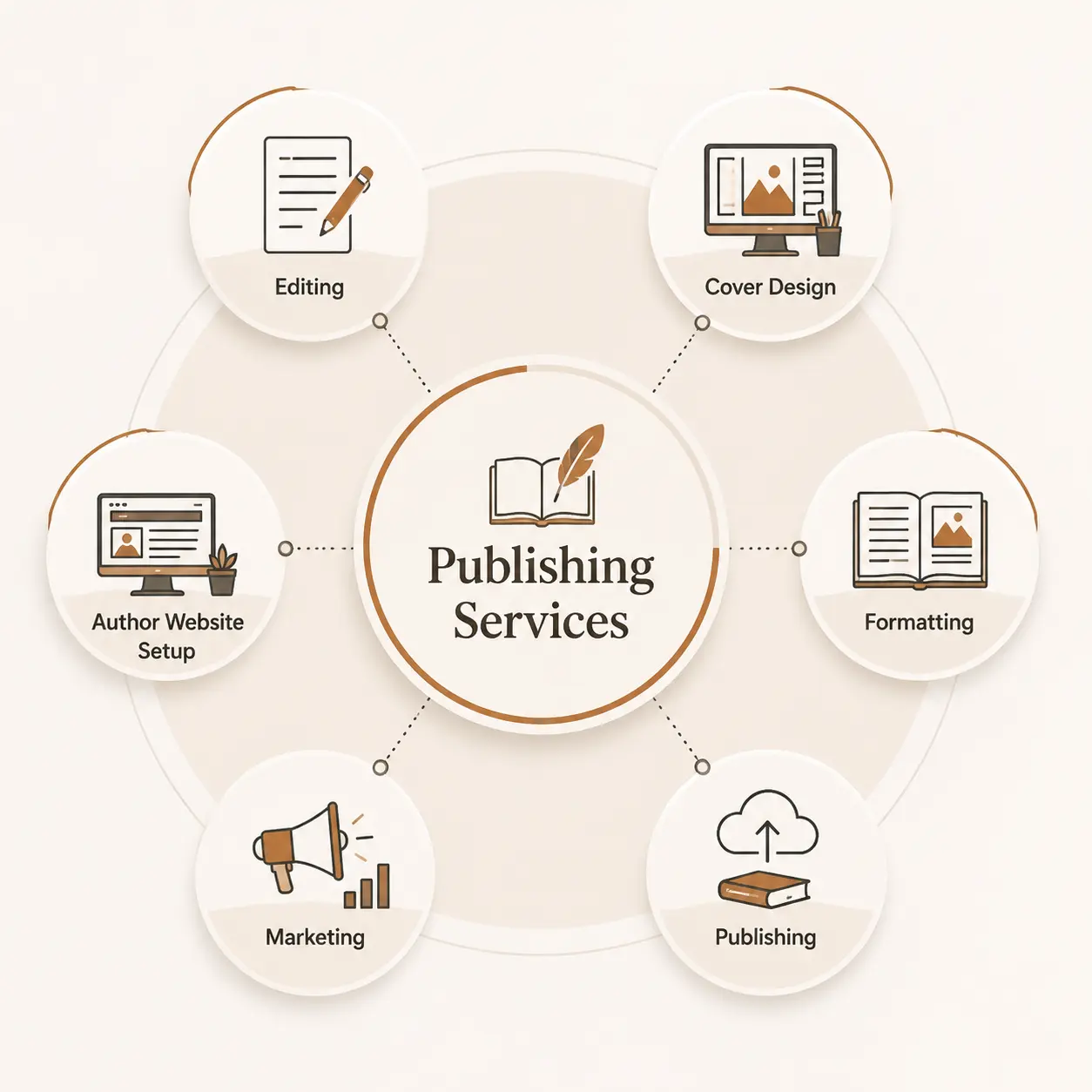
Many first-time writers have no idea that self publishing services even exist. These companies step in to assist authors who want to publish independently but do not possess every skill on their own.
What Self-Publishing Services Provide:
Additional Marketing Assistance (from some providers):
Press release writing
Basic author website setup
Small advertising campaigns on social media
For anyone searching for book publishing services in usa, the options continue multiplying every single year. The entire market for self publishing has reached $3.5 billion in 2025, and experts expect it to grow to $7.2 billion by 2032.
This kind of expansion indicates that more authors are deciding to pay for professional help instead of struggling with tasks they never signed up for.
Professional editing breaks down into several different levels. There is basic proofreading, catching typos and missing punctuation.
Deep editing on the other hand examines your story structure, your character arcs, or the strength of your arguments.
Cover design and formatting are performed after the final editing stage. Both are critical in the publishing process.
Cover design sells the book to people browsing online or walking past a shelf while formatting makes the inside pages look clean and readable so no one complains about unusual spacing or broken chapter headings.
Marketing assistance varies significantly from company to company. Some simply provide a checklist of tasks to complete while others write your book’s meta description, help you select the right categories on Amazon, or set up small advertising campaigns for you.
First-time authors needing guidance often finish their manuscript but now they have no idea what comes next. Publishing services offer them a clear path forward.
Busy writers who lack time usually have day jobs or families or both. They can afford to pay for editing and design because reclaiming twenty hours of their own time is worth the money.
Authors wanting professional quality understand how readers think. They also are aware of the fact that people judge a book by its cover, certainly, but also by how clean the first few pages appear. These writers use book publishing companies to compete directly with traditionally published books.
According to research, ninety-three percent of indie authors reported being happy with their decision to self-publish. Their satisfaction came from keeping creative control, earning higher royalties, and publishing much faster than the traditional route.
The best self publishing companies work well for authors who want that all-in-one experience and have a reasonable budget saved up. These packages save you from the headache of juggling multiple contracts.
What to Watch Out For
Hidden fees sneak into some contracts as additional charges for revisions, faster turnaround times, or premium placement on Amazon or other retailers.
Overly expensive packages cost significantly more than hiring freelancers directly. Take some time to compare prices across three or four companies before you commit.

New writers tend to encounter the same few errors repeatedly. These mistakes come from misunderstanding how publishing actually operates, not from a lack of talent or effort. Here are the four most common traps.
Some authors select a publishing path based on how it makes them appear rather than what it delivers for their specific book.
They pursue a traditional deal for the prestige without recognizing that 93% of self-published authors end up genuinely satisfied with their decision.
Many first-time writers believe a publisher handles all the promotional work. Even with a traditional contract, you still carry approximately half of the marketing load yourself.
Self-publishing requires upfront money for editing, book cover design, and formatting. Some authors begin without savings and consequently release a rushed product that readers overlook.
No publishing path guarantees rapid sales or automatic readers. So you should remember that building an audience requires time, patience, and consistent effort regardless of which route you select.
Neither publishing path is better than the other. Traditional publishing offers professional support and established distribution but requires you to give up any creative control and wait for years.
On the flip side, self-publishing provides freedom and higher royalties but places all financial and marketing responsibilities on your shoulders.
The best choice depends entirely on your personal goals, your available budget, and how much patience you possess for rejection or slow timelines. If you're ready to self-publish but don't want to manage book editing and formatting, cover design, and Amazon setup alone, our publishing team can guide you through every stage of the process.
Better depends entirely on your situation. Self-publishing works effectively for authors who desire full creative control, higher royalties per sale, and a fast timeline measured in months. Traditional publishing suits writers who value professional editing, bookstore distribution, and the credibility of a recognized publisher name. Neither choice guarantees sales or readers.
Start by finishing your manuscript and hiring a professional editor. Then decide between finding a literary agent for traditional publishing or using a platform like Amazon KDP for self-publishing. For the self-published route, you will also need a cover designer and formatting assistance. Many first-time authors use book publishing services to manage these steps.
No. You can publish a book entirely on your own through self-publishing platforms like Amazon KDP or IngramSpark. Millions of authors have done exactly that. Keep in mind that self-publishing places all the work on you, including editing, design, marketing, and distribution.
Yes. Amazon offers a free platform called Kindle Direct Publishing that permits anyone to upload a manuscript and sell it as an ebook or paperback. The process takes a few days and requires no upfront payment.
These are companies that assist authors with editing, design, formatting, and marketing of their books. The industry’s market size has reached $3.5 billion in 2025 and continues to expand as more writers select self-publishing as a professional option.